Cordless Stick Vacuums: Choose for the Floor Plan and Cleanup
Runtime claims are less useful than the rooms, surfaces, debris, charging place, and emptying routine in your home.
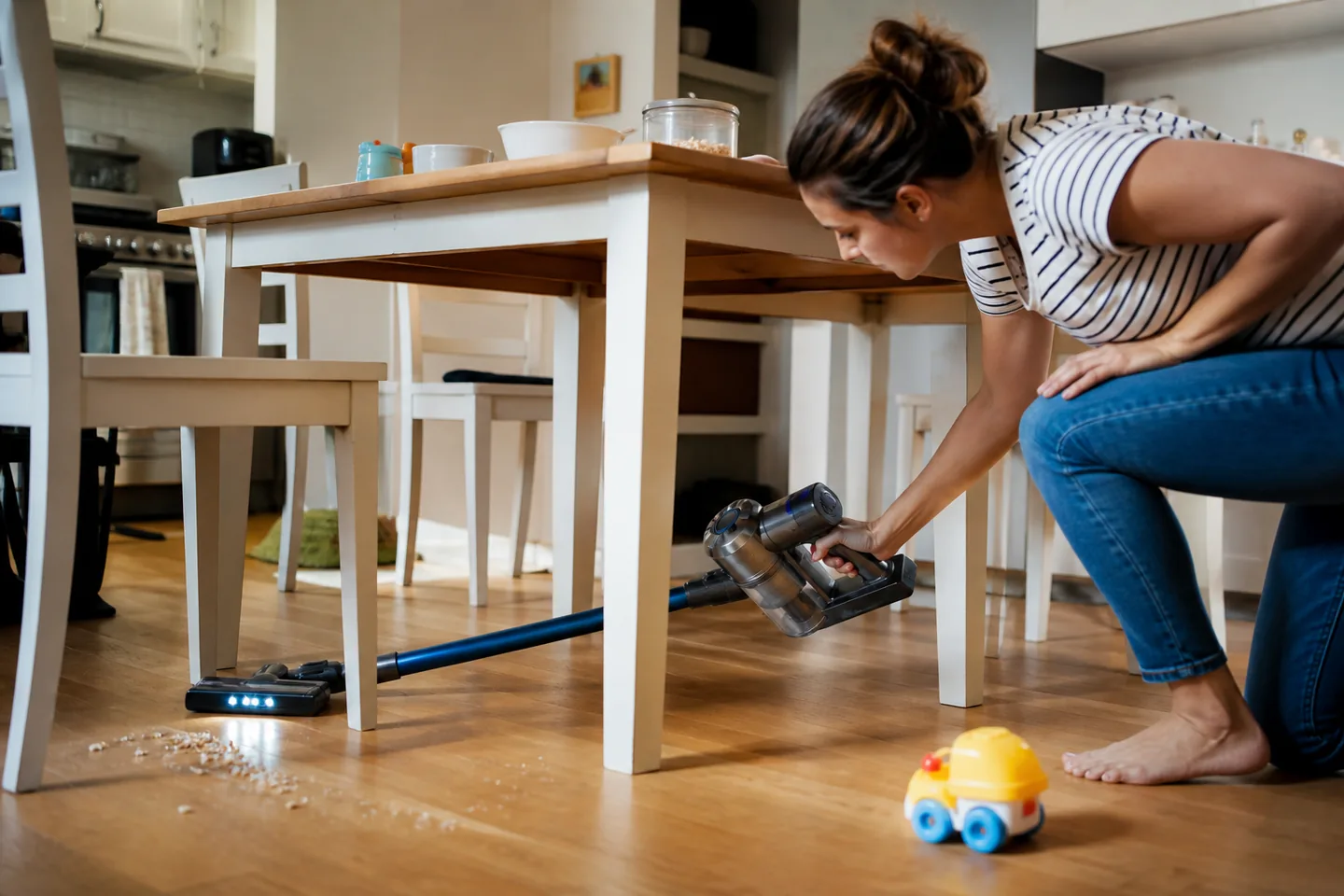
Original J. Casa Biancas lifestyle scene. Unbranded objects are illustrative and are not endorsements of a specific product.
Breakfast crumbs, an entry mat, and one rug need a quick pass before work. The vacuum helps when it is easy to reach, balanced in hand, and simple to empty without turning the task into maintenance.
Runtime claims are less useful than the rooms, surfaces, debris, charging place, and emptying routine in your home. Our approach starts with the real-life constraint before considering a product page. That keeps a useful feature from becoming a substitute for fit, comfort, care, or repeat use.
- Job to solve
- Map surfaces and typical cleanup size, then compare head design, weight in use, controls, battery and charging information, bin access, filters, storage, and parts.
- Best for
- Homes using frequent short cleanups across hard floor and selected rugs, with a dedicated charging location.
- Main compromise
- Larger batteries can extend use but add weight; smaller bins keep the body compact but need more frequent emptying.
Start with the routine, not the product
Map surfaces and typical cleanup size, then compare head design, weight in use, controls, battery and charging information, bin access, filters, storage, and parts. Write the actual setting down: the room, weather, schedule, clothing, tools, products, or storage that will surround the purchase. A clear setting gives every specification a job.
Homes using frequent short cleanups across hard floor and selected rugs, with a dedicated charging location. If that does not describe your routine, the right shortlist may look different. A good buying guide should make it easier to opt out, not make every reader feel that a purchase is overdue.
What is worth comparing
These are the four details we would put at the top of the comparison page. They are category criteria rather than claims about a particular model, and they should be checked against current product information before purchase.
- A floor head suited to the main surfacesCheck how this detail works in your routine, how it is maintained, and whether the seller describes it clearly.
- Weight judged at the handleCheck how this detail works in your routine, how it is maintained, and whether the seller describes it clearly.
- Clear battery and replacement informationCheck how this detail works in your routine, how it is maintained, and whether the seller describes it clearly.
- A bin and filter routine you will maintainCheck how this detail works in your routine, how it is maintained, and whether the seller describes it clearly.
Do not assume that a longer feature list represents higher quality. Extra parts, finishes, modes, and compartments can add cost and maintenance without solving the main problem. When two options appear close, prefer the one whose dimensions, materials, instructions, and return terms are easiest to verify.
The compromise to make deliberately
Larger batteries can extend use but add weight; smaller bins keep the body compact but need more frequent emptying.
A compromise is not a flaw when it is chosen consciously. It becomes a problem when a marketing page hides it behind a superlative. Compare the two sides using the place and frequency of use, not an imagined perfect scenario.
Also consider the cost after checkout: cleaning, replacement parts, special storage, compatible products, alterations, or the time needed to use the item well. A less expensive option that is ignored is not better value, and a premium option is not an investment unless it earns repeat use.
Who should skip this purchase
Skip a cordless model if the full cleaning route routinely exceeds its documented use pattern or there is no appropriate charging location.
Use what you already own as the baseline. If a current item can be adjusted, cleaned, repaired, or used differently to solve the same recurring problem, try that before adding another object. When safety, health, fit, or professional standards are involved, current instructions and qualified advice take priority over editorial guidance.
A five-minute pre-purchase checklist
- Write down the exact household routine this everyday home purchase needs to support.
- Measure the available space, route, storage location, and the person who will use or carry it.
- Check current product instructions, materials, dimensions, care, and seller terms before purchase.
- Test the shortlist against the main compromise: Larger batteries can extend use but add weight; smaller bins keep the body compact but need more frequent emptying.
- Confirm returns, replacement parts, and what happens after regular cleaning or maintenance.
- Save the current instructions and receipt where you can find them.
How to compare two finalists
Place both candidates against the same short list. First, remove any option that fails a non-negotiable measurement, material, compatibility, care, or safety requirement. Second, compare the feature you will notice most often. Third, read the return conditions before opening or altering anything.
Ignore tiny differences that have no role in your week. Product photography, color names, bundles, and bestseller labels can create urgency without clarifying fit. If information is missing, ask the seller or choose an option with better documentation rather than filling the gap with an assumption.
Finally, wait long enough for the reason to stay clear. A shortlist that still makes sense after the tab is closed is usually stronger than a decision built around a countdown, coupon, or social-media moment.
Care, storage, and repeat use
Before buying, decide where the item will live and how it will be cleaned. Read the current care instructions rather than relying on material stereotypes. The right storage prevents damage, keeps the item visible, and reduces the chance of buying a duplicate because the first one disappeared into a drawer.
Review the purchase after several real uses. Notice which feature mattered, what created friction, and whether the main tradeoff was acceptable. That information is more useful for the next decision than a generic rating because it belongs to your own routine.
Our bottom line
Runtime claims are less useful than the rooms, surfaces, debris, charging place, and emptying routine in your home. The strongest option will make this priority easy to verify: Map surfaces and typical cleanup size, then compare head design, weight in use, controls, battery and charging information, bin access, filters, storage, and parts. It should also make the compromise visible before checkout: Larger batteries can extend use but add weight; smaller bins keep the body compact but need more frequent emptying.
Frequently asked question
Can a stick vacuum replace every other vacuum?
It depends on floor area, surfaces, stairs, debris, storage, and the model's documented capability. Many homes use it for a defined quick-clean role.
How does J. Casa Biancas choose products?
This launch publishes category-level decision guidance based on current published information and practical scenario analysis. We do not claim hands-on testing, ownership, rankings, current prices, or universal winners. If future testing is performed, the article will identify the tester, method, sample, and limitations.